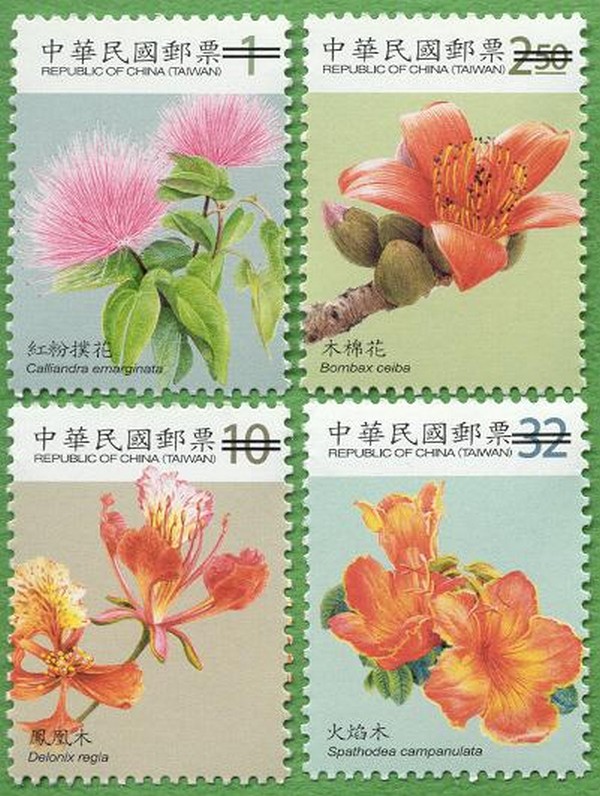
花卉郵票(第2輯)
發行日期:民國98年10月14日
繼98年3月12日發行「花卉郵票」系列常用郵票第1輯,本公司續以紅粉撲花、木棉花、鳳凰木及火焰木為題材,發行「花卉郵票(第2輯)」1組4枚,本組郵票規劃者為行政院農業委員會林業試驗所前所長金恆鑣博士與行政院農業委員會農業試驗所花卉研究中心主任謝廷芳博士,郵票圖案係委請柯鴻圖先生精心繪製,由中央印製廠以彩色平凹版印製,預定於98年10月14日發行。茲將本組郵票圖案簡介如下:
(一)紅粉撲花(面值1元):豆科,半落葉灌木,別稱凹葉紅合歡、粉紅合歡。葉片為二回羽狀複葉,長橢圓狀披針形,夜間會閉合,白天再展開;開花型態呈頭狀花序,腋生,花冠呈半圓形,花絲細長,密集,狀似粉撲,適合庭園景觀美化。
(二)木棉花(面值2.5元):木棉科,落葉喬木,又稱攀枝花、英雄樹。葉為掌狀複葉;花冠5瓣,萼杯形,有橙紅與紅兩色;果為蒴果,成熟後會自動裂開,散發出密披棉毛之種子。樹形具陽剛之美,四季各有不同的觀賞型貌,最大特色是先開花,後展葉。
(三)鳳凰木(面值10元):豆科,落葉喬木,幹基多有板根,樹冠呈傘狀,別名金鳳樹、紅花楹樹、火樹、九腳蹄。葉對生,二回羽狀複葉;花為頂生總狀花序,花瓣5枚,鮮紅色帶黃暈,花絲細長紅色,盛開於六月,常為畢業的象徵。鳳凰木植株高大,主供薪炭材、觀賞、行道樹之用。
(四)火焰木(面值32元):紫葳科,落葉喬木,別稱泉樹。葉對生,一回單數羽狀複葉,小葉卵狀長橢圓形;花為頂生圓錐花序,自圓形花苞外圍依序綻放,花色橙紅到豔紅,頂生於樹梢,宛如火焰。生長環境喜高溫及日照充足,普遍用為行道樹、庭園植物。
Flowers Postage Stamps (II)
First day of issue: 2009-10-14
Having issued the first set of definitive stamps on flowers on March 12, 2009, Chunghwa Post is going to follow up with a second set, featuring Calliandra emarginata, Bombax ceiba, Delonix regia, and Spathodea campanulata. This set of stamps was organized by Dr. Heng-piao Chin, the former director-general of the Taiwan Forestry Research Institute, Council of Agriculture of the Executive Yuan, and Dr. Ting-Fang Hsieh, director of the Floriculture Research Center, Agricultural Research Institute, Council of Agriculture of the Executive Yuan. The stamps were painted by Mr. Hung-tu Ko, and printed by
Central Engraving and Printing Plant in color deep-etch offset. The set of four stamps will be released on October 14, 2009. Details of these stamps are as follows:
1. Calliandra emarginata (NT$1.00): Calliandra emarginata, or powder puff, is a semi-deciduous shrub of the Fabaceae family. Leaves are bipinnately compound, with oval lanceolate leaflets. The leaflets fold together at night and unfold during the day. The inflorescence is axillary and capitulum. The corolla is semicircular, with dense long filaments, resembling a powder puff. It is a very good ornamental specimen.
2. Bombax ceiba (NT$2.50): Bombax ceiba, commonly known as cotton tree, is a deciduous tree of the Bombacaceae family. Leaves are palmately compound. Flowers are orange or red, with five petals. The calyx is cup-shaped. It produces a capsule which, when ripe, will burst open and disperse seeds that are covered thickly with cotton-like fibers. The tree has a masculine shape and looks different in all four seasons. One of its salient features is that it blooms before it leafs out.
3. Delonix regia (NT$10.00): Delonix regia—which is commonly known as royal poinciana, flamboyant, or flame of the forest—is a deciduous tree of the Leguminosae family. Most of them have buttress roots. The tree has an umbrella-shaped crown. Leaves are opposite and bipinnately compound. Each of its flowers, which are arranged in terminal racemes, has five petals, which are bright red with a touch of yellow, and its filaments are slender and red. Because the tree blooms in June, it is often used to symbolize graduation. The royal poinciana is a large tree and mainly used for firewood, or as an ornamental or street tree.
4. Spathodea campanulata (NT$32.00): Spathodea campanulata, or fountain tree, is a deciduous tree of the Bignoniaceae family. Leaves are opposite and pinnately compound, with oval leaflets. The inflorescence is in the form of a terminal panicle, with the outer buds blooming first. The flowers are orange scarlet, resembling flames on the crown of the tree. The fountain tree loves heat and sun light. It is commonly grown as a street tree and garden specimen.